City Directories and History: COL. JOHN STUART HOUSE
Constructed circa 1767-72; wing and piazzas added before 1850; restored with additions 1934
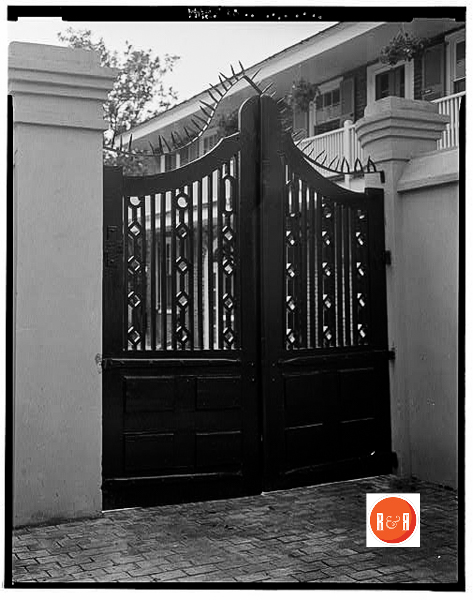
C.O. Greene, Photographer May, 1940 – Colonel John Stuart House, 106 Tradd Street, Charleston (3)
“A rare example of a side-passage plan from the Colonial period, this lavishly fitted house was built by John Stuart, a Scots-man who became superintendent of Indian affairs for the southern colonies and thereby held seats on the governors’ councils of Virginia, North Carolina, South Carolina, and Georgia. Stuart acquired the large lots at the southernmost end of the Orange Garden tract by mortgage to the owner woodwork in these rooms. He added a second floor to the polygonal wing and developed a formal French garden west of the house. Howells became a pivotal figure in the Charleston preservation movement in the 1930s and 1940s.. He fled the house in 1775, and it was sold in 1782 as confiscated property to the merchant Alexander Gillon. The exterior of the building has flush weatherboarding, pedimented window surrounds, and one of Charleston’s most elaborately carved wooden door surrounds: a pediment supported by engaged, fluted Corinthian columns, possibly derived from a plate in Edward Oakley’s Magazine of Architecture, Perspective, and Sculpture (1730). The first floor of the side wing and the piazzas were added in the nineteenth century. In the 1920s the woodwork from the first-floor sitting room and the large drawing room on the second floor was sold to the Minneapolis Institute of Arts for display in a period room. In 1934 the architectural historian John Mead Howells of New York and Portsmouth, New Hampshire, bought the property as a winter home and reproduced the original woodwork in these rooms. He added a second floor to the polygonal wing and developed a formal French garden west of the house. Howells became a pivotal figure in the Charleston preservation movement in the 1930s and 1940s.”
R&R HISTORY LINK: SCHS Mag. article; Early Indian Trade in S.C.” by P. M. Brown
Information from: The Buildings of Charleston – J.H. Poston for the Historic Charleston Foundation, 1997
Colonel John Stuart was appointed the King’s Superintendent of Indian Affairs for the Southern District in 1762. By 1765 he obtained full imperial status for his department and was active in handling the Indian affairs of East and West Florida. In 1770 he was named “councilor extraordinary” to advise the governors of Virginia, the provinces and their boards on Indian affairs. Stuart was arrested early in June 1775 on the charge of attempting to incite the Catawba and Cherokee in the British interest. He fled from Lady’s Island to Florida, where he remained until his death in 1779. John Stuart built the three-story frame residence about 1772. The house has a hipped roof, captain’s walk, and one interior chimney. The narrow south façade is flush boarded and the other elevations are clapboarded. First and second story windows in the narrow façade are flanked with dog-ear trim and crowned with bracketed triangular pediments. The fanlighted entrance is located on the left bay of the front elevation. Its frontispiece is highlighted by Corinthian pilasters and a denticulated pediment. The two-story piazza along the west side was added in the 19th century. Bedroom and service additions of two stories were also added at a later period. Listed in the National Register October 22, 1970; Designated a National Historic Landmark November 7, 1973. (Courtesy of the SC Dept. of Archives and History)
View the complete text of the nomination form for this National Register property.
Other sources of interest: Charleston Tax Payers of Charleston, SC in 1860-61 and the Dwelling Houses of Charleston by Alice R.H. Smith – 1917 The HCF may also have additional data at: Past Perfect and further research can be uncovered at: Charleston 1861 Census Schedule or The Charleston City Guide of 1872
Stay Connected
Explore history, houses, and stories across S.C. Your membership provides you with updates on regional topics, information on historic research, preservation, and monthly feature articles. But remember R&R wants to hear from you and assist in preserving your own family genealogy and memorabilia.
Visit the Southern Queries – Forum to receive assistance in answering questions, discuss genealogy, and enjoy exploring preservation topics with other members. Also listed are several history and genealogical researchers for hire.
User comments welcome — post at the bottom of this page.
R&R HISTORY LINK: SCHS Mag. article; “Gunpowder Plots in Revolutionary SC” by P.G. Swain
R&R HISTORY LINK: SCHS Mag. article; “Godin and Co., Charleston Merchants and Indian Trade, 1674-1715” by D.I. Bossy
R&R HISTORY LINK: SCHS Mag. article; Early Attempts at Indian Education” by F.J. Klingberg
R&R HISTORY LINK: SCHS Mag. article; “Alexander Cameron – British Indian Agent” by J.L. Nichols
R&R HISTORY LINK: TEXT – NR NOMINATION
R&R HISTORY LINK: NATIONAL REGISTER – IMAGES(S)
Please enjoy this structure and all those listed in Roots and Recall. But remember each is private property. So view them from a distance or from a public area such as the sidewalk or public road.
Do you have information to share and preserve? Family, school, church, or other older photos and stories are welcome. Send them digitally through the “Share Your Story” link, so they too might be posted on Roots and Recall.
Thanks!