

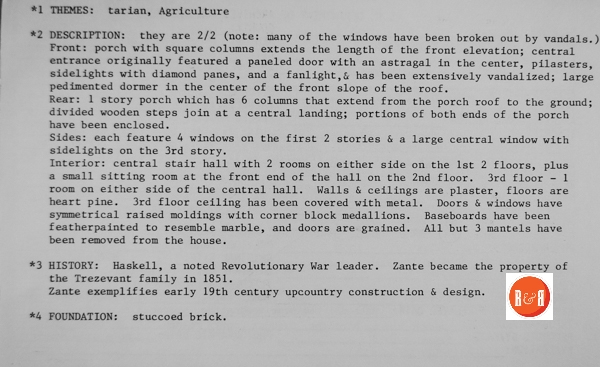
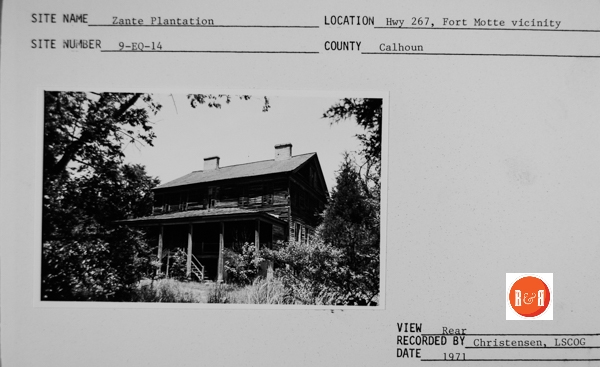
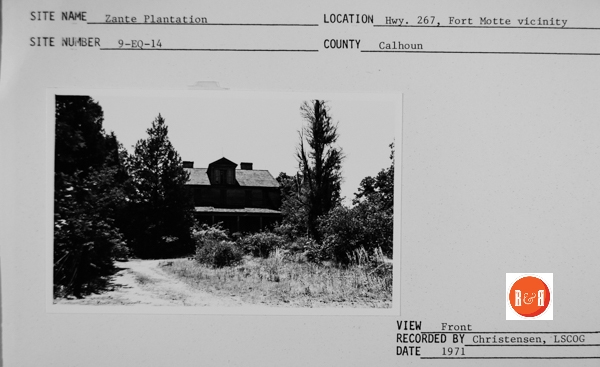
City Directories and History: Zante Plantation is a two and one-half story frame structure with Federal details built upon a stucco-over-brick foundation approximately seven feet high. It is not known exactly when Zante was constructed, however architectural analysis suggests its having been completed between 1810 and 1820. The house is an example of the progression of the Carolina upcountry farmhouse from a simple cottage to a more imposing structure. Both front and rear facades have one-story porches, and square wooden columns support the front porch.
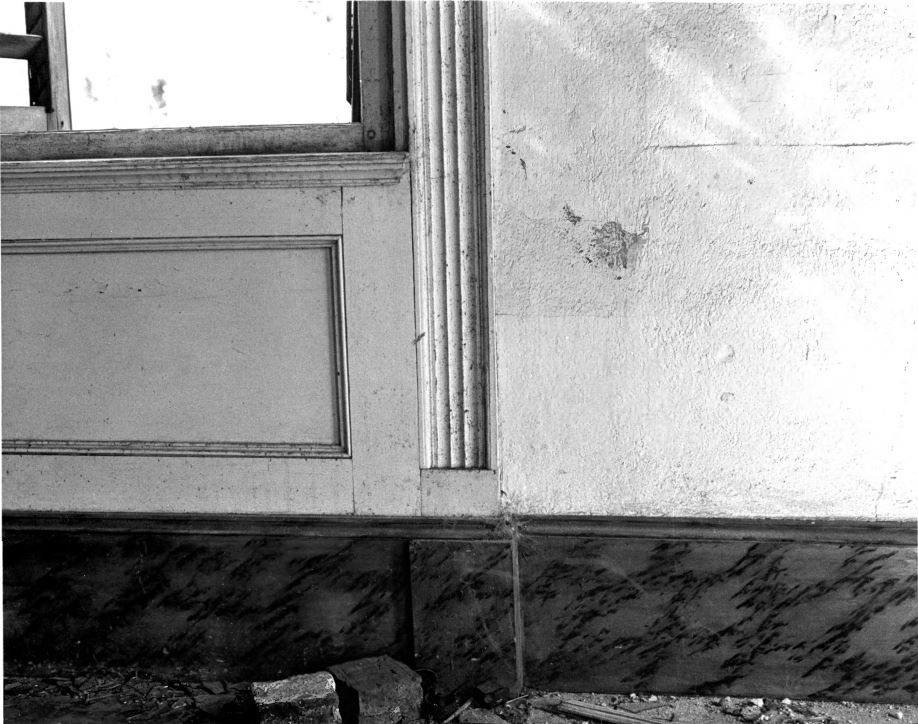
Image showing the painted baseboard of the Zante Plantation. Courtesy of the SC Dept. of Archives and History
Simple wooden steps lead to the front entranceway. A large dormer window with sidelights and a central fan medallion is located on the gable roof, directly above the entrance. The entrance is flanked by pilasters, sidelights, and a fanlight above. The eaves of the roof are slightly extended with dentil moldings. The roof is tin. The wide central hall features an elliptical arch and terminates in a stairway with three flights. The interior displays delicate paneling and moldings, feather-grained baseboards, and door and window jambs with fluted pilasters and corner medallions. Several original outbuildings remain on the property. Zante has been the home of several prominent South Carolinians, its history reaching as far back as the late eighteenth century when Peter Manigault, Speaker of the Commons House of Assembly, acquired the property. After the Revolutionary War, Major William Elnathan Haskell, of the Massachusetts Continental line, settled in South Carolina, marrying into one of the state’s most noted families, the Thomson’s. In 1851, Zante became the property of the Trezevant family, another of the state’s most prominent early families. Listed in the National Register June 29, 1976.
Zante has been the home of several important South Carolina families, its history reaching back to the late 18th Century when Peter Manigault acquired the property. Although it is presently in need of restoration, Zante is significant architecturally, exemplifying early 19th Century up-country construction and design. In 1771 Peter Manigault, Speaker of the Commons House of Assembly, began acquiring property in the area known today as Calhoun County. (Manigault belonged to one of the wealthiest and most influential French Huguenot families in the province of South Carolina and acquired large tracts of property throughout the province.) By his death in 1773 he had assembled a plantation consisting of 2,224 acres. Manigault’s sons, Joseph and Gabriel, inherited their father’s estate, including this Calhoun County property. In 1788, Joseph and Gabriel Manigault divided their inheritance. The lands in the present day Calhoun County area became the property of Joseph. In 1809 Joseph sold the property to Major William Elnathan Haskell, a noted Revolutionary War leader. According to tradition, there was at this time a structure on the Manigault property which Haskell moved to the present site of Zante. (Broken bricks, plaster and other articles can still be found at the place called “Manigault” which coincides with the traditional location of the structure.) Also suggestive of an earlier structure are portions of Zante’s foundations which appear to be of an earlier construction date. The Haskells called the plantation “Zante” and it remained in their possession at least through 1830. In 1823 Charles Thomas Haskell, son of William Elnathan Haskell and a student at Harvard, listed his address as Zante Plantation, St. Matthew’s Parish. (It is interesting to note that Zante is a Greek island in the Ionian Sea. Meaning “wooded” and mentioned by Homer, it was regarded as a place of beauty and pleasant living.)
(Courtesy of South Carolina Department of Archives and History) Click here for the National Register site.
Zante Plantation, which had belonged to the Manigaults, was the home of Charlotte Thomson and her husband Major Elnathan Haskell, who were married in 1791, and established their residence here on the Congaree conveniently located about three miles by the river from Belleville, Charlotte’s home place. Zante was given as a wedding present to Charlotte Ann Thomson by her father William Thomson. The plantation’s name was taken from Zante (Zacynthus in Homeric Greek) an island in the Ionian Sea noted for its beautiful gardens and vineyards. Zante in its early days had beautiful gardens and a maze of boxwood hedges which led up to its entrance. The house has been moved several miles back from the river but it still stands intact. At the present time Mrs. Rosa Trezevant Hane lives at the old place where she receives friends and relatives in the genuinely gracious Southern manner.
Also: Mrs. Jacqueline Trezevant Wienges Patrick of Greenwood sends a valuable correction of our account of Zante Plantation: “Calhoun County Plantations of St. Matthew’s Parish near the Congaree-Santee River,” Vol. XII, p. 47. Her account states that Major Elnathan Haskell bought Zante from the Manigault family in 1809. In 1851 William Baker of Sandy Run purchased Zante as a wedding present for his daughter Ann Elizabeth, who married James David Trezevant, son of the prominent physician, Dr. Daniel Heyward Trezevant of Columbia, November 23, 1851. Zante remained in the Trezevant family until 1975.
(Information from: Names in South Carolina by C.H. Neuffer, Published by the S.C. Dept. of English, USC)
Stay Connected
Explore history, houses, and stories across S.C. Your membership provides you with updates on regional topics, information on historic research, preservation, and monthly feature articles. But remember R&R wants to hear from you and assist in preserving your own family genealogy and memorabilia.
Visit the Southern Queries – Forum to receive assistance in answering questions, discuss genealogy, and enjoy exploring preservation topics with other members. Also listed are several history and genealogical researchers for hire.
User comments welcome — post at the bottom of this page.

R&R HISTORY LINK: CHARLESTON CONNECTIONS
R&R HISTORY LINK: NATIONAL REGISTER – IMAGE(S)
Please enjoy this structure and all those listed in Roots and Recall. But remember each is private property. So view them from a distance or from a public area such as the sidewalk or public road.
Do you have information to share and preserve? Family, school, church, or other older photos and stories are welcome. Send them digitally through the “Share Your Story” link, so they too might be posted on Roots and Recall.
Thanks!

User comments always welcome - please post at the bottom of this page.



Share Your Comments & Feedback: