Pocotaligo Road
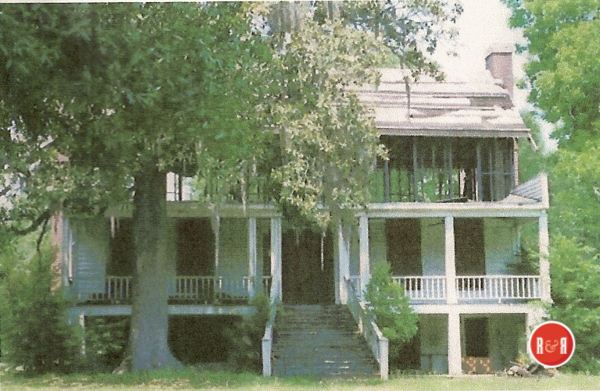
Image courtesy of Lori Krueger – Hoffman
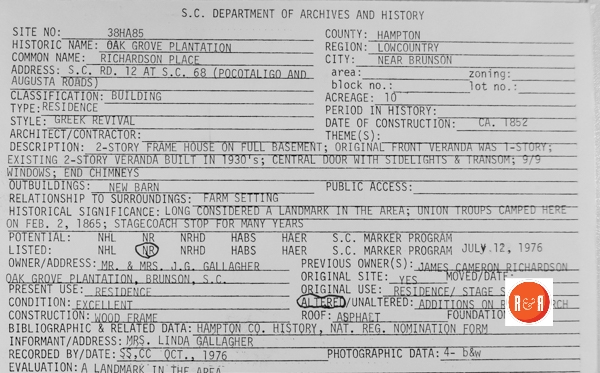
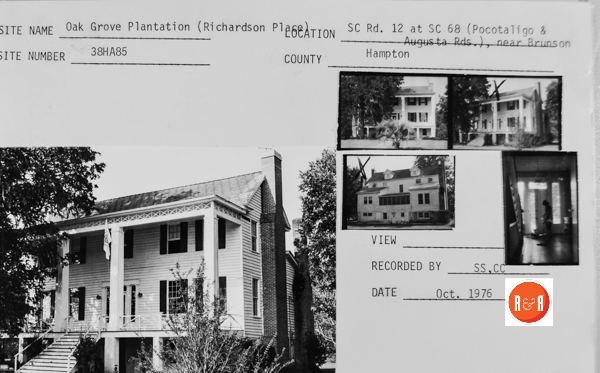
City Directories and History: (Richardson Place) According to tradition, Oak Grove was built in 1852 by James Cameron Richardson. Oak Grove is a two-story clapboard structure of the Greek Revival style resting upon a raised basement. Wooden steps lead to a veranda that extends the full two stories of the front façade. The veranda at the rear was enclosed in 1935. The interior has features indicative of a simple, yet well designed and well-constructed house. The mantels are simple, the paneling is hand-hewn pine, and the window moldings are essentially plain. The open staircase is unadorned, having square balusters. The agricultural census for Prince William’s Parish, Beaufort District, in 1850 listed James C. Richardson as the owner of 1,375 acres of which 450 were improved. The cash value of his farm at the time was $4,300. It is believed that General William T. Sherman visited Oak Grove during the Civil War. Supportive of this tradition is Sherman’s Memoirs, which record the night of February 2, 1865 being spent at the nearby Duck Branch Post Office. Oak Grove’s outbuildings, including slave cabins, have since been torn down; however their location is known. The original oaks for which the plantation was named were cut for lumber in 1957. Listed in the National Register July 12, 1976.
“James Cameron Richardson built this house on the old Pocotaligo to Augusta ca. 1852. The two-story frame house brick foundation built with a central hall floor plan. There chimneys. Windows are six over six (6/6) lights with during the Greek Revival Period, Oak Grove is in the farmhouse with shed rooms in the rear and a porch between. verandah was raised during a 1930’s remodeling to the full the residence.”
Information from: Historic Resources of the Lowcountry, The Lowcountry Council of Government, Cynthia C. Jenkins, Preservation Planner – Published, 1979
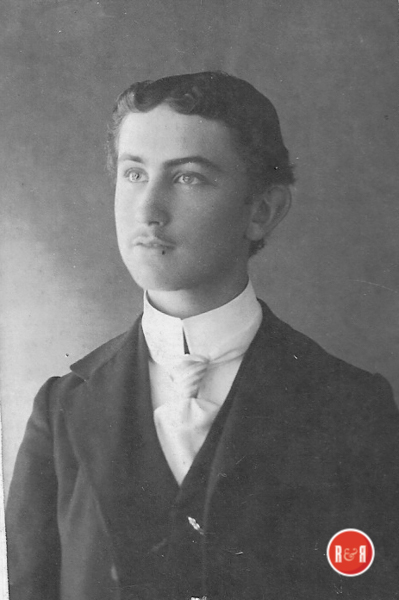
This once stately, white two-story Colonial home flanked by large magnolias is at the intersection of Bo Peep Road (also called Matthews Bluff Road) and Pocotaligo Road (several miles out from Brunson). It was built by James Cameron Richardson, who married Esther Henrietta Thames Richardson, first cousin of William Edgar Brunson, Sr. Their son, Cameron Gregg Richardson married Harriet Angelia Zenobia Brunson, daughter of William Edgar Brunson, Sr.
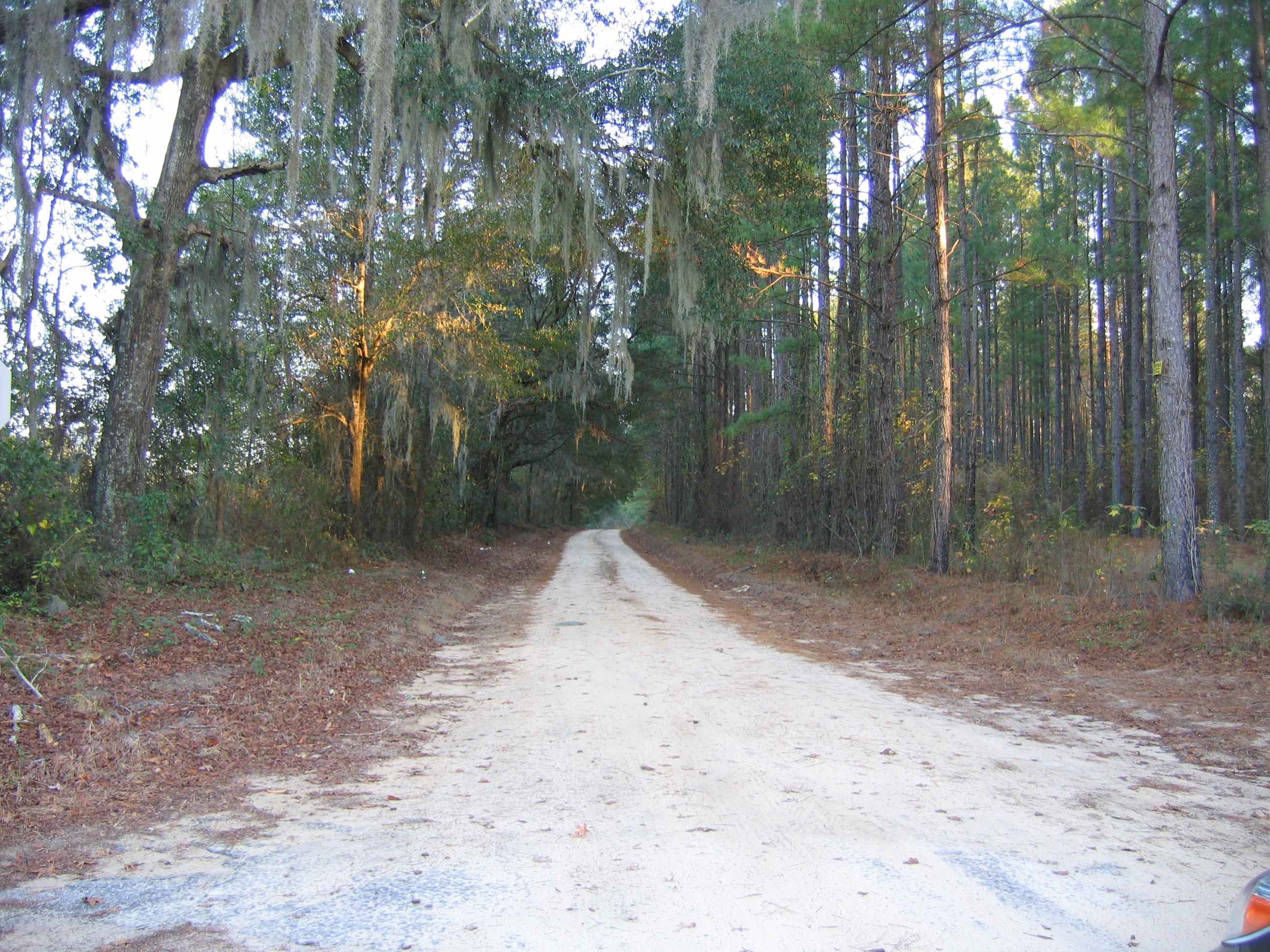
Pocotaligo Road was the stagecoach road that ran from Pocotaligo Station to Augusta. It is a picturesque, typically Old South, sandy, tree-lined road that runs in front of the Oak Grove Plantation, where the stagecoach made regular stops. Legend says that the road received its name from two little Indians playing with a cooter (turtle) and saying, “Poke ‘e tail, ‘e go!” Image courtesy of Lori Krueger – Hoffman
Many homes in the South “boast” of Sherman’s troops encamping for the night on their lands. So does Oak Grove, but with impressive documentation: On page 273 of Memoirs of General Wm. T. Sherman (Georgia Historical Society), Gen. Sherman wrote the following: “I camped the night February 2, 1865 at Duck Branch Post Office, 31 miles from Pocataligo.” (The distance today is exactly 31 miles from Pocataligo to the Richardson Place; and although, the exact location of the Post Office is unknown, Duck Branch runs very near the Richardson Place and flows into the Coosawhatchie River, where this editor as well as most of those growing up in Brunson learned to swim, with water moccasins and alligators as companions!). When Union troops came in February 1865 during the “War of Northern Aggression,” the plantation house was saved because the Union commanding officer respected the property of Mr. Richardson, who was a fellow Mason and who gave him the Masonic sign. Officers, commanded by the commanding officer not to allow any further damage, guarded each entrance to the home. The troops had earlier set fire to the house three times, but Mrs. Richardson managed to have them put out each time. A whole corp. of 22,000 marauders encamped on the grounds, eating, looting, and destroying. The valuables of the house had been hidden, but after cajoling a hitherto faithful house slave, Dinah, into telling them where the wine was stashed, they got her drunk and she revealed all. In recent times, sadly, the second story of the house succumbed to fire.
Information courtesy of the Brunson Tour Guide – Brunson Family Reunion Committee, 2006
Stay Connected
Explore history, houses, and stories across S.C. Your membership provides you with updates on regional topics, information on historic research, preservation, and monthly feature articles. But remember R&R wants to hear from you and assist in preserving your own family genealogy and memorabilia.
Visit the Southern Queries – Forum to receive assistance in answering questions, discuss genealogy, and enjoy exploring preservation topics with other members. Also listed are several history and genealogical researchers for hire.
User comments welcome — post at the bottom of this page.

NATIONAL REGISTER IMAGE(S)
Please enjoy this structure and all those listed in Roots and Recall. But remember each is private property. So view them from a distance or from a public area such as the sidewalk or public road.
Do you have information to share and preserve? Family, school, church, or other older photos and stories are welcome. Send them digitally through the “Share Your Story” link, so they too might be posted on Roots and Recall.
Thanks!

User comments always welcome - please post at the bottom of this page.


Share Your Comments & Feedback: