City Directories and History: One of Greenville’s oldest residences, Whitehall is an interesting example of the cool, breeze-acclimated summer homes favored by South Carolina’s first summer vacationers, escaping from the lowcountry heat and humidity to the cooler “high hills” of the upcountry. Whitehall was built as a summer residence by Charlestonian Henry Middleton on land purchased from Elias T. Earle in 1813. Middleton, a member of one of South Carolina’s most 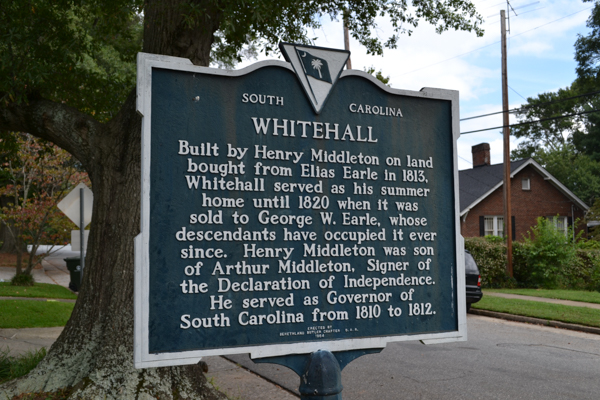 prominent families, son of Arthur Middleton (signer of the Declaration of Independence), was himself a president of the Continental Congress, a U.S. Senator, a member of the S.C. House of Representatives and Governor of South Carolina as well as one-time Minister to Russia.
Whitehall served as Middleton’s summer home until 1820, when it was sold to George Washington Earle, son of Elias T. Earle. A simple white frame structure with shuttered windows, the most distinctive features of the house are the wide first and second story galleries, or piazzas, which serve as cool and shady breezeways. The Barbadian style of architecture was adopted by Charlestonians in the eighteenth century when they discovered that piazzas added to existing houses formed cool, outdoor summer living rooms. In time, the piazzas became an integral part of every newly constructed dwelling in Charleston and the planters used similar designs in the upcountry summer houses like Whitehall. Listed in the National Register August 5, 1969.
View the complete text of the nomination form for this National Register property.(Courtesy of South Carolina Department of Archives and History)
“Significant Greenville houses on the Register include the two in-town residences credited with being the city’s oldest: Earle Town House (c. 1810) at 107 James Street, home of South Carolina writer, Mary Simms Oliphant, and Whitehall (c. 1813) at 310 West Earle Street, the C. B. Dawsey residence. Both were built on the original plantation lands of the pioneer Earle family who came from Virginia shortly after the Revolution, and both retain a park-like atmosphere with tree-shaded grounds and walkways. The Earle House was the homesite of Elias T. Earle, state senator from Greenville District, U.S. Congressman, silk grower, manufacturer, Commissioner of Indian affairs. Nearby Whitehall was built as a summer residence by distinguished Charlestonian Henry Middleton on land purchased from Elias Earle in 1813.”
Information from: Names in South Carolina by C.H. Neuffer, Published by the S.C. Dept. of English, USC
Stay Connected
Explore history, houses, and stories across S.C. Your membership provides you with updates on regional topics, information on historic research, preservation, and monthly feature articles. But remember R&R wants to hear from you and assist in preserving your own family genealogy and memorabilia.
Visit the Southern Queries – Forum to receive assistance in answering questions, discuss genealogy, and enjoy exploring preservation topics with other members. Also listed are several history and genealogical researchers for hire.
User comments welcome — post at the bottom of this page.

TEXT – NR NOMINATION

NATIONAL REGISTER – IMAGE(S)
Please enjoy this structure and all those listed in Roots and Recall. But remember each is private property. So view them from a distance or from a public area such as the sidewalk or public road.
Do you have information to share and preserve? Family, school, church, or other older photos and stories are welcome. Send them digitally through the “Share Your Story” link, so they too might be posted on Roots and Recall.
Thanks!