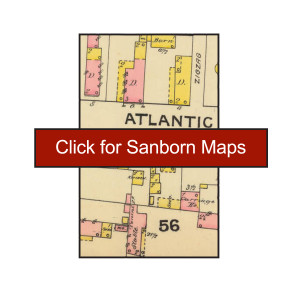

City Directories and History: Known as the “Great Secessionist,” Robert Barnwell Rhett was one of the most effective and prominent of that circle of pro-slavery “fire-eating” radicals. Rhett in South Carolina joined with others like William Lowndes Yancey of Alabama to launch a carefully programmed campaign to sever the slaveholding states from the Union. Unlike the constitutional unionists or cooperationists, such as Robert Toombs, for whom secessionist feelings evolved from the collapse of the compromises and disintegration of the national parties, Rhett sought 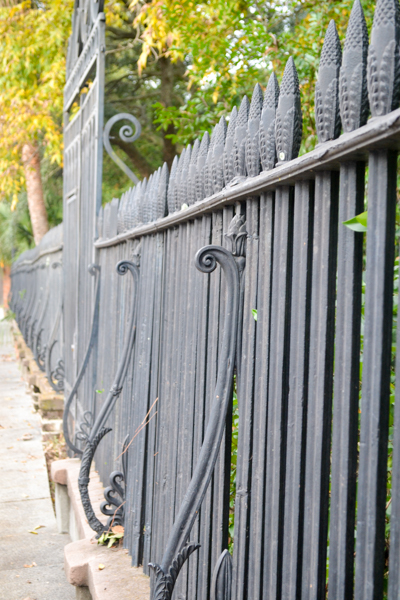 secession early and eagerly.
He utilized his newspaper, the Charleston Mercury and his eloquence to discredit any opportunity for compromise and was instrumental in unifying South Carolina’s resistance to the central government. He successfully fought off attempts to postpone the State’s secession convention. In addition, he had a major influence on the State’s Ordinance of Secession and wrote the “Address to the Slaveholding States,” a report of South Carolina’s act of separation and a call to like-minded states to join her. Rhett was born in Beaufort, South Carolina in 1800, the 8th child of James Smith.
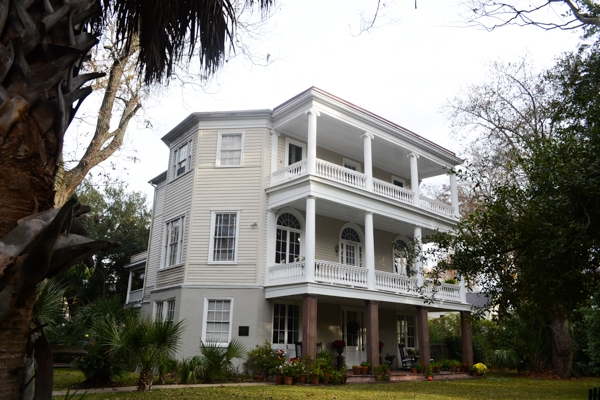
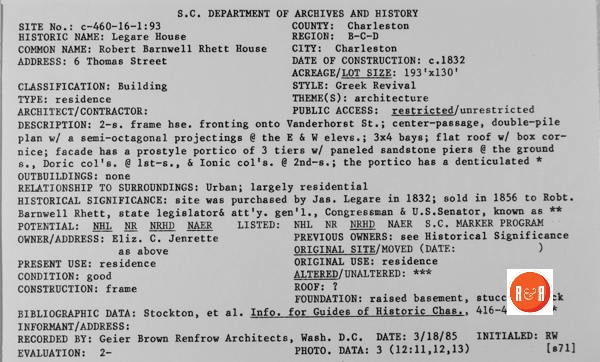
By wise investment in plantations he increased his wealth until by 1850 he had 190 slaves on two estates. He maintained a town residence in Walterboro and later, both in Charleston and Georgetown. Only the boyhood home in Beaufort and the Charleston townhouse remain. This house, built ca. 1832, is a large single-family clapboard frame dwelling of two stories on a raised basement. It has a modified Charleston “double house” plan. Listed in the National Register November 7, 1973; Designated a National Historic Landmark November 7, 1973. [Courtesy of the SC Dept. of Archives and History]
*** Also see Rhett’s speech coverage in the Camden Journal, Aug. 2, 1850
LEGARE-RHETT HOUSE
Constructed 1855; restored mid-1980s
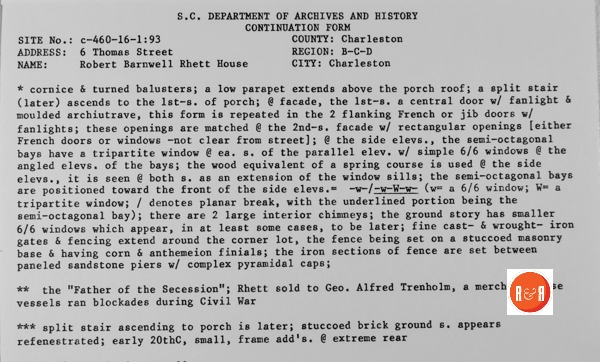
“This house was built by James Legare in 1833 and sold to Robert Barnwell Rhett, a politician best known for his title the “Father of Secession.” In 1863 the Rhett family sold the house to George A. Trenholm of 172 Rutledge Avenue, the wealthy merchant whose ships were used as blockade runners during the Civil War and who became a Confederate secretary of the treasury. Theodore D. Wagner bought the property in 1866 and quickly resold it in 1867 to Thomas M. Hanckel, a trustee for Mrs. Susan H. Hanckel, for 510,000. The Hanckels owned the property for seventy-five years; they sold the house in 1940 to the Shahid family.
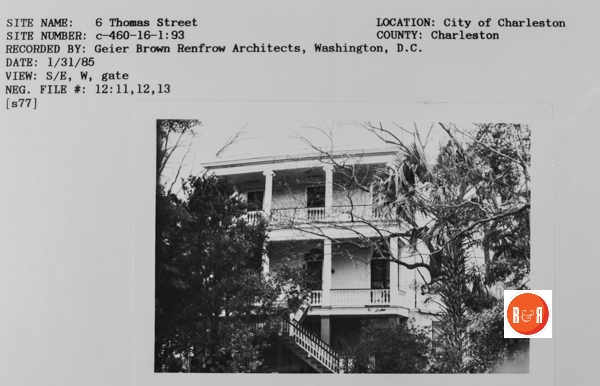
The wooden Greek Revival dwelling with flanking bays and three-story porticoes was built on a high, stuccoed brick basement
R&R HISTORY LINK: SCHS Mag. article; “The South Atlantic Blockading Squadron” by A.A. Brayton
within brownstone piers. Interesting characteristics of this house are the polygonal bays, which create two large octagonal rooms on each floor.”
Information from: The Buildings of Charleston – J.H. Poston – Author, for the Historic Charleston Foundation, 1997
“This tall house, two stories of wood on a high, stuccoed brick basement, was built probably soon after 1832, when the site was purchased by Jame Legare. ln 1856 the property was sold to Robert Barnwell Rhett, state legislator and Attorney General, Congressman and U.S. Senator. For his strong state rights stand and his advocacy of an independent Southern confederacy, he became known as the “father of secession.” It was also the home of Robert Barnwell Rhett, Jr. , editor of the very pro-secession , and later of the New Orleans and of the , and a state legislator. The Rhetts sold the house in 186– to George Alfred Trenholm, who kept it until 1866. Trenholm was a wealthy shipping merchant whose vessels became blockade runners during the Civil War. Tradition relates that during the War a young lady of the house said goodbye to her fiancee at the west gate on the Vanderhorst Street side. She promised the gate would remain shut until he returned. He was killed in the war and, according to tradition, the gate has remained shut ever since. The house is Greek Revival , with flanking bays.” (Thomas, DYKYC, Dec. 23, 1968) – CCPL
“In 1851, I took part in politics again. The secessionists had held several meetings in Chester District. The Union or Cooperation party, thought it expedient to hold a meeting at Chester C. H. on the first Monday in August. Barnwell Rhett came up on Saturday. The secessionists had runners out on Sunday at all the churches summoning in their party, so as to outnumber the Cooperationists and pass resolutions over them. On Monday, it was so arranged that I should take the chair and Mr. Rhett be invited to open the discussion; each side being limited to an hour and a half. A watch was on the stand to note the time. When the time was out, I gave a rap and he closed. Mr. McAliley replied, occupying the same time. Rhett then had half an hour to reply, during which he was very sarcastic; belittling McAliley as an up country lawyer, with a great lack of constitutional knowledge. But this was a great mistake in Rhett. McAliley, in reply, far exceeded him in sarcasm and severe cuts, and when the discussion of four hours ended, Rhett went off the stand, apparently chagrined and disappointed, and his party completely defeated.” DANIEL G. STINSON
The Article Published Herewith Will Doubtless be of Interest to Many Chester County People….Copied from an Issue of The Yorkville Enquirer dated October 2nd 1878.
(Information courtesy of and from: CDGHS Bulletin)
Other resources: Charleston Tax Payers of Charleston, SC in 1860-61, Dwelling Houses of Charleston by Alice R.H. Smith – 1917, Charleston 1861 Census Schedule, 1844 Map of Charleston, and a 1872 Bird’s Eye View of Charleston, S.C. The Hist. Charleston Foundation may also have additional data at: Past Perfect
Stay Connected
Explore history, houses, and stories across S.C. Your membership provides you with updates on regional topics, information on historic research, preservation, and monthly feature articles. But remember R&R wants to hear from you and assist in preserving your own family genealogy and memorabilia.
Visit the Southern Queries – Forum to receive assistance in answering questions, discuss genealogy, and enjoy exploring preservation topics with other members. Also listed are several history and genealogical researchers for hire.
User comments welcome — post at the bottom of this page.
R&R HISTORY LINK: SCHS Mag. article; “Running the Blockade – the I. and E. Company” by L.W. Skelton
R&R HISTORY LINK: ANOTHER SECESSION STORY – ABBEVILLE SC
R&R HISTORY LINK: ANOTHER SECESSION STORY
R&R HISTORY LINK: NATIONAL REGISTER – IMAGES(S) “Increase”
Please enjoy this structure and all those listed in Roots and Recall. But remember each is private property. So view them from a distance or from a public area such as the sidewalk or public road.
Do you have information to share and preserve? Family, school, church, or other older photos and stories are welcome. Send them digitally through the “Share Your Story” link, so they too might be posted on Roots and Recall.
Thanks!

User comments always welcome - please post at the bottom of this page.


Share Your Comments & Feedback: