City Directories and History:
Other sources: Charleston Tax Payers of Charleston, SC in 1860-61, Dwelling Houses of Charleston by Alice R.H. Smith – 1917, Charleston 1861 Census Schedule, and a 1872 Bird’s Eye View of Charleston, S.C. The Hist. Charleston Foundation may also have additional data at: Past Perfect
Stay Connected
Explore history, houses, and stories across S.C. Your membership provides you with updates on regional topics, information on historic research, preservation, and monthly feature articles. But remember R&R wants to hear from you and assist in preserving your own family genealogy and memorabilia.
Visit the Southern Queries – Forum to receive assistance in answering questions, discuss genealogy, and enjoy exploring preservation topics with other members. Also listed are several history and genealogical researchers for hire.
———
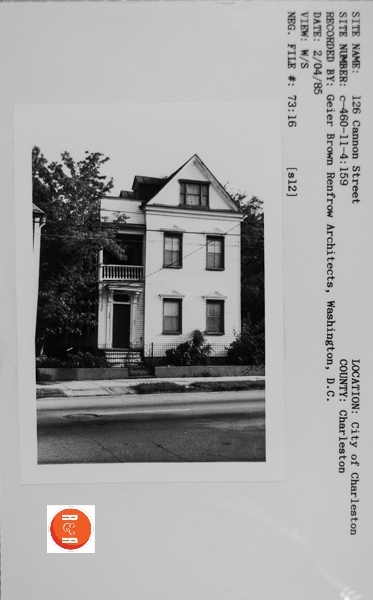
The two-and-a-half story Charleston single house at 126 Cannon Street is a fine example of the dwellings popping up in the Neck area of Charleston in  the years leading up to the Civil War. The house, built in 1853-1854, features a two-story piazza on the west side and a tripartite window in the front gable.
Susannah F. Harvey conveyed a lot to Andrew Kerr on April 7, 1818, in trust for the benefit of her children.[1] The lot was 100 wide along Cannon Street by 175 feet deep and was bordered by Joseph Righton (west), Charles Holmes (north), and Elizabeth Vale (east). Today, that lot comprises both 124 Cannon Street and 126 Cannon Street. A house was mentioned in that deed, and Mr. Kerr was a broker living on Cannon Street in the Islington area in 1819.
Margaret Kerr and others sold the property to Henry Burn, Sr. on March 21, 1842,[2] and Henry and William Burn, both planters in St. Andrew’s parish, occupied the property in 1851 and 1852. Since the 1852 Bridgens & Allen map shows the undivided lot with just one house at the southeast corner (where 124 Cannon Street stands today), 124 Cannon Street or a predecessor must have been the home for the Burns and perhaps even Mr. Kerr, thirty years earlier.
Henry Burn[3] sold slightly less than half of the lot to Henry A. Burn, Jr. for $800 on October 19, 1853.[4] That price suggests there was no house on the land, but when the property was assessed in 1854, the two-and-a-half story house was present. Henry A. Burn, Jr. sold the 35 foot wide lot with the new house to Capt. William A. Bradley for $3200 on January 9, 1860.[5]
Capt. Bradley was a conductor for the South Carolina Railway Co. A notice of his death extolled his politeness and attention to passengers: “There is hardly a family in Charleston which has not, at some time or other, been indebted to him for thoughtful care while traveling. No other escort was needed for lady or child when Capt. Bradley was in charge.”[6] He served as the first chief of the Palmetto Division, Order No. 208 of the Order of Railway Conductors in about 1887.
After the death of Capt. Bradley, an advertisement for the house was placed in 1887 that listed six main rooms, two more in the attic, and a bathroom.[7] The outbuildings were “new and most convenient.” Most of the copy was devoted to the gardens: “[The house] has beautiful Flower Garden, containing as fine collection of roses, camellias, &c as any in the city.” Several months later, on July 13, 1888, the estate of Capt. Bradley sold the house to John H. Steffens for $5000.[8]
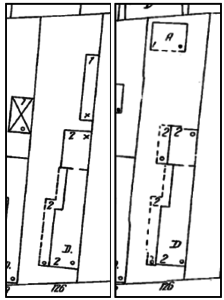
Between the 1902 and 1944 editions of the Sanborn maps, the rearmost portion of the house had porches added, and the outbuildings were changed.
Mr. Steffens had bad luck while occupying the house: The house was struck by lightning and the rear gable severely damaged in 1890,[9] and in 1916, Mr. Steffens had to call the police to shoot a mule at the house.[10] A comparison of the house in the 1902 and 1944 Sanborn maps shows that a thin, one-story structure disappeared but that a one-story garage was added to the rear, right corner of the lot. The vanishing building was probably the stables that burned down in 1910 in a fire.[11]
Mr. Steffens had served during the Civil War at Bachman’s battery with the Hampton Horse Artillery.[12] Mr. Steffens died on January 26, 1919, but Mrs. Catherine Steffens occupied the house until her own death in February 1930.
After Mrs. Steffens died, the house was received by John Edwin Bulwinkle. The relationship between Mrs. Steffens and Mr. Bulwinkle is unknown, but he also served as the executor of her estate. Mr. Bulwinkle[13] and his wife, Anna Gesine Mohr Bulwinkle, lived in the house at least 1934 to 1948.
It seems that Mr. Bulwinkle was responsible for converting the house into a rental property. Although members of the Bulwinkle family occupied part of the house, so too did renters.[14] In the 1940 census, the house had been divided into three units, although how physical the divisions were between the units is unknown.
Mr. Bulwinkle sold the house to Martha S. Watson on February 9, 1953, for $11,000.[15] Mr. Hezekiah and Mrs. Martha Watson occupied the house with members of their extended family in addition to renting part of it.[16] Viola S. Chisolm (a possible sister-in-law of Mr. Watson) received the house on December 29, 1999.[17]
Brett W. Johnson and Michelle D. Soltysik bought the house for $335,000 on May 11, 2004.[18]
[1] Deed book A9, page 26
[2] Deed book I41, page 20
[3] (b. abt. 1802; m. Adeline Burn)
[4] Deed book A13, page 411
[5] Deed book J14, page 50
[6] “Capt. W.A. Bradley,” Charleston News & Courier, Mar. 10, 1889, at 2
[7] Charleston News & Courier, Sept. 27, 1887, at 5
[8] Deed book H19, page 369
[9] “The Downpour of Rain,” News & Courier, Aug. 10, 1890, at 8
[10] “Mule Put to Death,” News & Courier, Jan. 4, 1916, at 3
[11] “Early Morning Fire,” News & Courier, May 30, 1910, at 5
[12] Mr. J.H. Steffens Dead, Charleston News & Courier, Jan. 28, 1919, at 10
[13] (b. abt. 1890)
[14] Occupants included Leon F. Bulwinkle (1938); Mr. and Mrs. Nicholas Margiotta (1939-41); Mr. Louis K. and Louise G. Palmer (1940); Mr. John and Leonora Bulwinkle (1940); Joseph G. Scott (1942); Mrs. Sallie DuBose (1943-45); Henry B. McManus (1948).
[15] Deed book L56, page 491
[16] Occupants included William C. Frierson (1955-61), Thomas Golden (1958-71), and Mrs. Viola S. Golden (1973-75).
[17] Deed book B340, page 733
[18] Deed book E494, page 175
Please enjoy this structure and all those listed in Roots and Recall. But remember each is private property. So view them from a distance or from a public area such as the sidewalk or public road.
Do you have information to share and preserve? Family, school, church, or other older photos and stories are welcome. Send them digitally through the “Share Your Story” link, so they too might be posted on Roots and Recall.
Thanks!

User comments always welcome - please post at the bottom of this page.


Share Your Comments & Feedback: