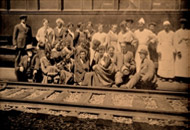
“A rich farming area of highly influential Americans….”
City Directories and History: Robert L. Meriwether in The Expansion of South Carolina has this to say of Moses Thomson: Moses Thomson made his home at the mouth of Halfway Swamp; and the settlement on the lower portion of that stream of others, residents if not natives of the province, shifted the center of gravity of the township to the southeast. This brought into the affairs of the community a group of Santee planters hitherto little” interested in Amelia.
The Devil’s Track Place was the home of Rachel Heatly and her husband John Lloyd. The plantation house was in the vicinity of Buckhead Hill near McCord’s Ferry on the Congaree River. The name by which this place is known derives from one of those rare old tales that bring children in from play and old men from the chimney corners.
John Lloyd had a compelling weakness for a dark, Satanic profanity, which his good wife Rachel sadly deplored and sought to correct. One evening a smoothly suave stranger, driving a handsome gig and bearing some unmistakable earmarks of Old Nick appeared at John Lloyd’s house. After a congenial supper with the Lloyds, the stranger began to tempt John into uttering dreadful oaths and wild profanity. Rachel, realizing that this was indeed Satan bent on damning her husband eternally, determined to thwart the ancient adversary.
Samuel G. Stoney, an incomparable raconteur, completes the legendary tale thus:
“She got off into the next room with her Bible, opened it to the last page, and began to read it backwards. As she read she could hear through the walls the creature she knew to be the Devil tempting her husband toward the brink of ultimate blasphemy. The words which would assure his eternal damnation, she fended off with Holy Writ. She held out to the third cock crow. At its sound the Devil leaped up from the table, ran out to the porch, and took a tremendous jump, to a rock on the highest point of Buck Head Hill, and cannoned from it across five miles of river swamp to the land in the forks of the Congaree and Wateree. The horse hitched itself to the gig and bounded over the rock and after its master. Conveniently for posterity, the track of the gig and deep prints of the mismatched feet have remained in that senseless thing.”
Fort Motte, located on a high bluff overlooking the Congaree River, was the home of Colonel Isaac Motte and his wife, the heroic Rebecca Motte. Their house was seized by the British in 1781 and used as a fort; hence the name Fort Motte was given to the plantation and to the historic little village which grew up near by. It was here that Rebecca Motte suggested to Marion and Lee that they use the burning arrows which ignited the roof of her own home and resulted in the surrender of the British.
Hampden Hall was built by Edward Richardson and later passed to the Thomson family when John Linton Thomson acquired the place. Dr. William Russell Thomson lived here just before the Confederate War. The house was burned during the War. The name apparently derived from Hampden Manor in Buckinghamshire, the ancestral home of the Hampden family.
Hartland Plantation was the home of Major Derrill Hart and his wife Rebecca Thomson. It was inherited by their son, Dr. Derrill Hart, who married his first cousin, Charlotte Ann Thomson. The origin of the name is obvious.
Heatly Hall was the house seat of the Heatly family, descendants of Richard Heatly who had moved to land along the Santee in 1719 and had married Mary Sterling, daughter of George Sterling, the first settler of the region. Lang Syne Plantation, lying just a few miles from Ft. Motte, was in its early days associated with Ann Heatly Reid Lovell, who inherited the land from her Heatly-Russell kin.
Next the Dulles and Cheves families lived at Goshen and Lang Syne and in later years the Peterkins. A plot of Lang Syne and Goshen made by John N. Barrillon, District Surveyor, in 1836 shows the land as owned by the Hon. Langdon Cheves. The combined acreage of the two places was 2,703 acres. Langdon Cheves, distinguished South Carolina lawyer, member of congress, and Pres. of the United States Bank, married Mary Elizabeth Dulles, thus acquiring Lang Syne. It has been handed down traditionally that Cheves named the plantation Lang Syne for it represented to him an escape from his arduous duties as Congressman in Washington and President of the United States Bank in Philadelphia to the good old times.
The Goshen part of the estate took its name from the Biblical Goshen, a rich and prosperous land. of his youth. In more recent times Lang Syne has been owned by the Peterkin family; and it has been particularly dear to many people since it was the home of Julia Mood Peterkin, who came to live at Lang Syne as the bride of William George Peterkin. It was here that Julia Peterkin lived among and loved the Negroes of her husband’s plantation. She was able to tell so much of the truth about them for she knew and loved them first as friends and distinctive human beings. They later became the people of her novels, but they never ceased to be her friends. Some present-day landmarks on Lang Syne are Joyner Hill (pronounced Jina Hill), a wooded hillside known for
years for its thin-shelled hickory nuts; and Mulberry Ridge, a boundary line between sections of the plantation, and along which are found the cabins of the quarters.
The Oakland Plantation house was built by William Sabb Thomson circa “William Sabb Thomson was born 10 November 1785 at Richmond Hill 4 o’clock morning 1800. The Charlotte Ann Thomson Bible has the following family records on William: “William Sabb Thomson was married unto Eugenia Ann Lewis 9 July 1809 at Mount Thomson.” The Oakland house still stands just behind large trees and approached by a circular drive which goes around the house. At an earlier time there were in front of the house many large oak trees from which the plantation derived its name. It is now occupied by Mrs. Nell Peterkin Reid, a Thomson descendant; and Oakland Plantation is owned by Mrs. Reid and her two sons, Sam Fraser Reid and Jeff Goodwyn Reid.
Some of the interesting topographical names connected with Oakland are Stop Crack, Jane Cut, Sugar Hill, and Spring Grove.
Stop Crack indicated originally the place where Midway and Oakland joined. Jane Cut is the name given to a large field on the place. No explanation of this name has as yet been discovered. Sugar Hill and Spring Grove are subdivisions of Oakland.
Pond Bluff Plantation was the home of Dr. Artemus Thomson Darby and his wife Margaret Cantey Thomson. This plantation joined Oakland and Midway. Dr. Artemus Thomson Darby has the distinction of being the omega of South Carolina’s revered Secession Ordinance: he was the last signer. Pond Bluff has one unique topographical name: Can Hill, an elevation on the place, said to derive its name from the fact that money had been buried there in a can. The Wienges family, who now own the place, call it Can’t Hill.
-

- Images of cabins and other buildings in the Belleville Community by photographer, Ann L. Helms – 2019

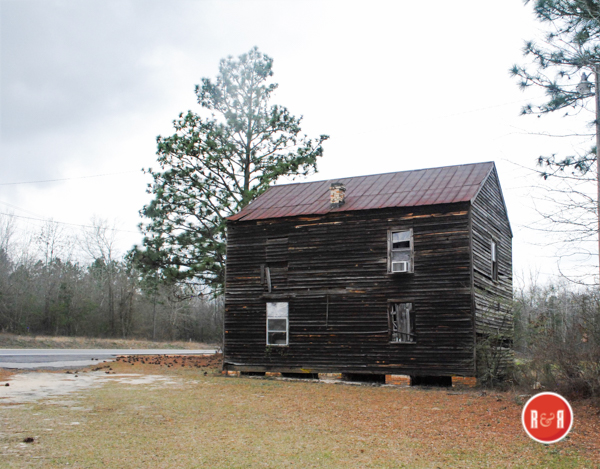
Totness was the pineland village to which the plantation gentry of St. Matthew’s Parish removed in the summer to escape from the malarial lowlands of the Congaree and the Santee. Here the planter families maintained regular households to be occupied for several months during the year. There was an Episcopal Chapel which provided for the welfare of their souls, a village doctor to take care of their physical ailments, and a race track which afforded diversion for a people of Cavalier rather than Puritan tastes. The name Totness was apparently derived from the old Devonshire town along the Dart River, holding a charter from Henry VII (1505) which stated that the Mayor must be elected on St. Matthew’s Day. Thus it was a fitting name for the village seat of these South Carolina Anglicans of St. Matthew’s Parish.
True Blue Plantation quite naturally took its name from the rich blue of the indigo grown here. The plantation is located on Highway 601 about eight miles from St. Matthews. It was in its early days the home of Richard Singleton, who lived here in the 1830’s. It later passed to the Manning family, and in the 1880’s belonged to Richard I. Manning, son of Governor John L. Manning (1852- 1854) and first cousin of Governor Richard I. Manning (1915-1919). In 1886 the plantation house burned, and on December 8, 1887, Richard I. Manning wrote a letter to Mrs. T. K. Legare in which he speaks sadly of the loss of the house at True Blue, saying he considers it the garden spot of the world. This letter is now in the possession of Mrs. Nell Peterkin Reid of Oakland Plantation.
The name True Blue survives in Calhoun County as the designation of a creek also. The name is reminiscent of John Bennett’s fictional Blue Hill Plantation and its mansion, Indigo House, setting of his novel The Treasure of Peyre Gaillard.
Zante Plantation, which had belonged to the Manigaults, was the home of Charlotte Thomson and her husband Major Elnathan Haskell, who were married in 1791, and established their residence here on the Congaree conveniently located about three miles by the river from Belleville, Charlotte’s home place. Zante was given as a wedding present to Charlotte Ann Thomson by her father William Thomson. The plantation’s name was taken from Zante (Zacynthus in Homeric Greek) an island in the Ionian Sea noted for its beautiful gardens and vineyards. Zante in its early days had beautiful gardens and a maze of boxwood hedges which led up to its entrance. The house has been moved several miles back from the river but it still stands intact. At the present time Mrs. Rosa Trezevant Hane lives at the old place where she receives friends and relatives in the genuinely gracious Southern manner.
(Information from: Names in South Carolina by C.H. Neuffer, Published by the S.C. Dept. of English, USC)
Stay Connected
Explore history, houses, and stories across S.C. Your membership provides you with updates on regional topics, information on historic research, preservation, and monthly feature articles. But remember R&R wants to hear from you and assist in preserving your own family genealogy and memorabilia.
Visit the Southern Queries – Forum to receive assistance in answering questions, discuss genealogy, and enjoy exploring preservation topics with other members. Also listed are several history and genealogical researchers for hire.
User comments welcome — post at the bottom of this page.
Please enjoy this structure and all those listed in Roots and Recall. But remember each is private property. So view them from a distance or from a public area such as the sidewalk or public road.
Do you have information to share and preserve? Family, school, church, or other older photos and stories are welcome. Send them digitally through the “Share Your Story” link, so they too might be posted on Roots and Recall.
Thanks!