“One of York County’s antebellum leaders of controversy.”
HISTORY THREAD
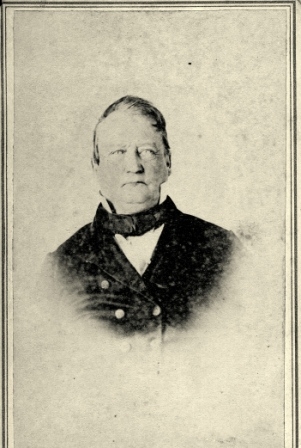
City Directories and History: After the death of William Campbell, Elizabeth (Hart) Campbell married Rev. Archibald Whyte in 1838. He was born in New York State in 1800 and died on Aug. 8, 1865, in S. C. Formerly a minister of the Associate Synod, Mr. Whyte later became a member of the South Carolina House of Representatives. His first marriage was to Susan N. Grier, sister of Col. William Grier, who was an elder in Steele Creek Associate Church. Susan (Grier) Whyte died in 1834, leaving Mr. Whyte with one daughter, Margaret J. Whyte, who later married John B. Lewis of Lewis Turnout, Chester County, S. C. A daughter of this union, Susan Grier Lewis, was married on Dec. 14, 1881, to Rev. John Alexander White, of the Associate Reformed Presbyterian Synod. By his second wife, Elizabeth (Hart) Campbell, Rev. Archibald Whyte had two sons: James T. Whyte, who removed to Tennessee, and William Whyte, who was born Mar. 4, 1842, and was married on Dec. 5, 1867, to Margaret Frances Steele of Rock Hill, daughter of Joseph Alexander and Elizabeth Jacolina (Kirkpatrick) Steele. The only child of William and Margaret Frances (Steele) Whyte to live to maturity was a son, Hope Whyte. He and his wife and their children ultimately lived at Hopkins, S. C., not far from Columbia.
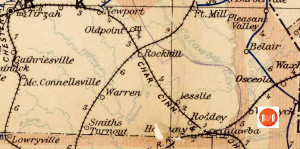
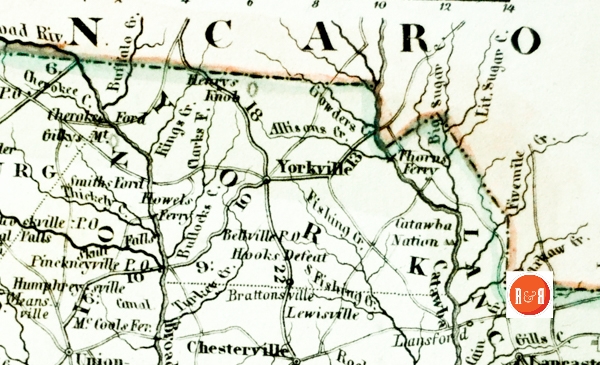
Postal map showing Rock Hill as a transportation hub on two railroads in 1896. Courtesy of the Un. of NC
What we do know comes from several surviving letters from Rev. A. Whyte to Capt. A E. Hutchison. Transcriptions of these letters follow this sheet. The reader can draw his own conclusions about the matter. On one side we have Eccles, Jonathan N. McElwee, Jr., and James Bynum. On the other side of the matter there are Mr. Whyte, Captain Hutchison, Maj. Richard A. Springs, Col. Cadwallader Jones, and perhaps others. All these men fervently wanted a newspaper for Rock Hill – a sure sign that the village was becoming a town and the town might become a city one day. But there was a decided difference between the two sides on what could be done and what should be done to save the paper. Eccles was irresponsible according to the word of Mr. Whyte: McElwee had his fingers in too many pies to be effective in anything: and James Bynum was a “good” writer interested in selling his creations to a publisher. Captain Hutchison, Major Springs, and Colonel Jones were the great planters of the neighborhood who believed that they had something to be gained from seeing Rock Hill prosper – and a newspaper was, to them, a sure and certain sign of progress and success. The Reverend Mr. Whyte was a semi-retired Associate Reformed Presbyterian clergyman, but he was also a slave-owning planter and former member of the South Carolina House of Representatives. He was a New Yorker who moved south when his colleagues in the Empire State shunned his pro-slavery views at Presbytery meetings in the North. His was an anomalous position – but an interesting one all the same. And, too, he was highly educated and was always promoting cultural pursuits for the planter class, to who he had committed himself, body and soul. His was the genius behind the Indian Land Agricultural Society. He tended toward glorifying and justifying the position of the planter leadership of the Old South – aided and sustained by their Negro servants and field hands. Mr. Whyte’s career was an odd marriage, to say the least. [Along the Land’s Ford Road, Vol. II by Wm. B. White]

James Bynum’s receipt for tuition received from Mrs. Anne H. White in 1853 for schooling at the early Rock Hill school located on Pendleton Street.
An extensive collection of Rev. Archibald Whyte’s papers are held at the Fairfield County Museum in Winnsboro, SC.
The Indian Land Agricultural Society was created for the purpose of improving farm operations and for social meetings of its members that were broken into districts as follows: Page 66 – April 7, 1860; North of the Landsford, and East of the Rail Road, will be styled the North East Section and will comprise the following members: J.J. Watson, Thomas Whitesides, D.J. Rice, LN. Massey, D.F. Schooly, William Sturgis, R.A. Springs, A. Whyte, and Joseph A. Steele.
That portion lying South of the Landsford and East of the Rail Road, will be (styled the South East Section) embrace the following members: Greene Ferguson, W.B. Daniel, Samuel Anderson, J.N. McElwee, Jr., W.E. Waters, Allen Robertson, David Williams, J.F. Workman, Dr. Jordan, W.N. Poag, with Hugh Simpson, D.C. Roddey, S.S. Elam, W.W. Moore in Rock Hill.
That portion lying South of the Landsford, and West of the Rail Road, will be styled the South West Section and will embrace the following members: W.P. Thompson, D.D. Mony, Richard Sadler, William Erwin, R.E. Guthrie, Edward Moore, N.A. Steele, Wiley L. Little, James Gaulden, John Starr, W.B. Wilson, John Biggars, J.M Rawlinson, C.P. Sandifer, J.M Lowry, R.G. McCaw and J.L. Miller, J.G. Enloe, Yorkville.

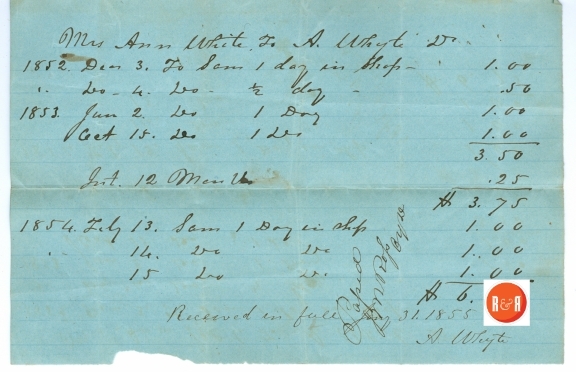
Payment by Mrs. Ann H. White for tuition at the Rock Hill Academy, signed by A. Whyte. Courtesy of the White Family Collection – 2008
That portion lying North of the Landsford and West of the Rail Road, will be styled the North West Section, and will comprise the following members: John Massey, B.F. Rawlinson, R.J. Adams, J.S. Barnett, John A. May, Henry L. Killian, Thomas S. Neely, Joe W. Rawlinson, Stephen Johnson, S.M Johnson, J. McElwee, Sr., J.W. Clawson, A.B. Springs, J.L. Moore, Williams Simril, Wiley Reeves, A.E. Hutchison and Cad… Jones.
Click on the More Information > links found below the primary picture column for additional data and pictures, including a comprehensive article on the Rev. Archibald Whyte.

Mr. J.J. Watson who was a member of the Agricultural Society listed on this page also worked as a carpenter for Mrs. Ann White in 1857. Courtesy of the White Family Collection – 2008
Researcher Linda Blackwelder on 9.27.14 submitted the following information: [Archibald Whyte was at one time the minister of Steele Creek Associate Presbyterian church, which had broken away in 1804 from Steele Creek ARP, commonly known as “Blackstocks Church” which was on today’s Carowinds Blvd and sat just inside of the South Carolina line. His 1st wife was Susan Grier, a member of the AP church above. Susan died in child birth the next year and he remained there until 1840. He actually gave up the ministry when the word came down from the Synod of the ARP Church in Pennsylvania told the southern churches that they had to free their slaves. Taken from my book, “The History of Central Steele Creek Presby”I quote the following: (taken from Synod records) It was during this time that the Associate Synod of the North began to admonish the Associate Presbytery of the Carolinas because of their views on slavery. Finally, when the Synod passed their “Act on Slavery”, Dr. Whyte and the Associate Presbyterian Synod of the Carolinas was suspended in June, 1840, until such time they acknowledged their sin, and returned to their duty….” In August, 1840, the Rev. Dr. Thomas S. Kendall was sent to the Carolinas to explain and enforce the views of the Synod. It was after this visit that Dr. Whyte demitted his charge at Little Steele Creek and Back Creek, and out of sympathy with his Presbytery, declined to enter the union with the Associate Reformed Synod of the South. On April 14, 1844, he left the ministry all together and became a planter and politician. It was during this time that he married a 2nd time to Mrs. Elizabeth Hart Campbell.” After he left the church, Little Steele Creek AP and Steele Creek ARP were joined back together and 40 years later, built a church “centrally “ located between the two churches….thus today’s Central Steele Creek Presby Church, which left the ARP church in 1911 and joined the Mecklenburg Presbytery. ]
Membership in R&R
Stay connected with R&R, “Explore S.C. history, historic houses, & family stories…” Sign up for a free R&R membership. Members receive the “From the Porch” blog, updates on regional topics, and targeted notifications of their choice. Membership also includes travel opportunities: Carolina DeJaunts. Login and prioritize your specific points of enthusiasm. If you only wish to receive the “From the Porch” newsletter and no additional membership content, use the R&R Blog signup form.
User comments welcome – post at the bottom of this page.
HISTORY THREAD #3
HISTORY THREAD #2
Please enjoy this structure and all those listed in Roots and Recall. But remember each is private property. So view them from a distance or from a public area such as the sidewalk or public road.
Do you have information to share and preserve? Family, school, church, or other older photos and stories are welcome. Send them digitally through the “Share Your Story” link, so they too might be posted on Roots and Recall.

User comments always welcome - please post at the bottom of this page.


Share Your Comments & Feedback: