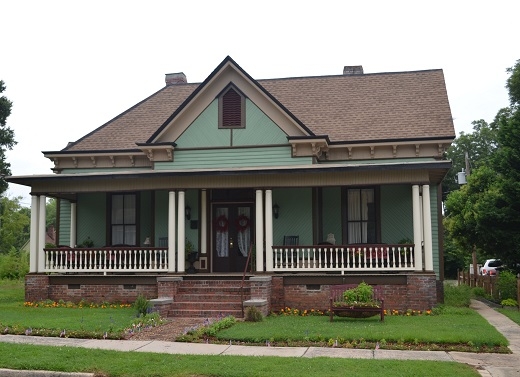
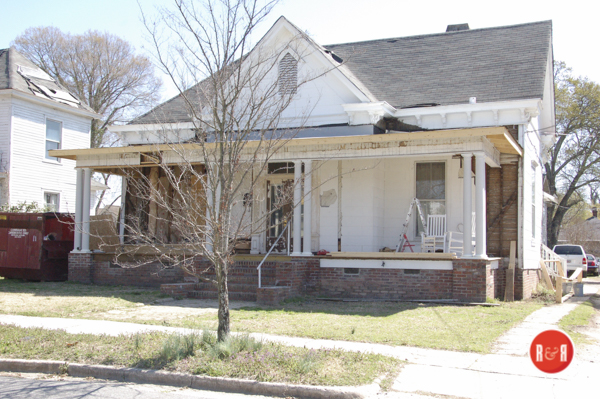
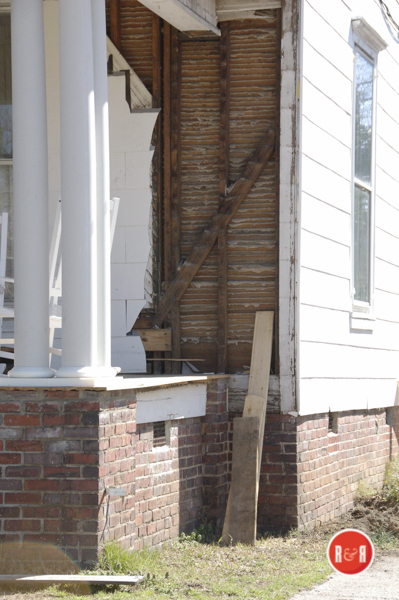
 Restoration by the Woods Family in the early 21st century.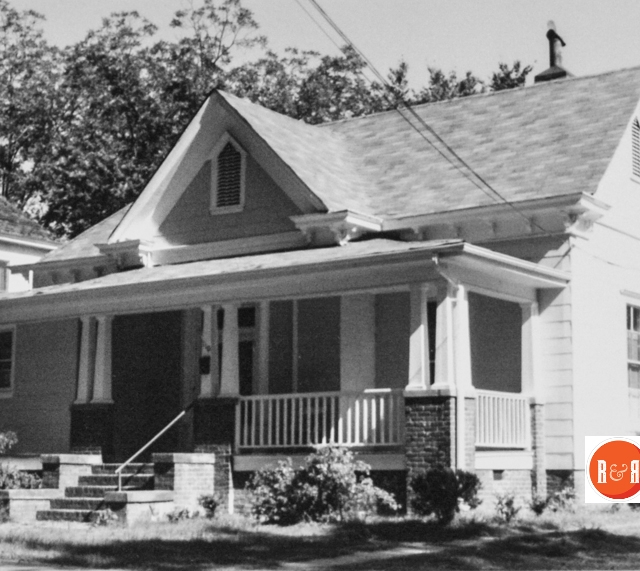
The Rock Hill Herald reported on Sept. 6, 1888 – “Mr. P.C. Poag has left Rock Hill for Lancaster, where he will be in business as a partner of Mr. J.M. Hood. They will deal in buggies, carriages, wagons, furniture, coffins, etc., later on the 27th Mr. P.C. Poag has disposed of his business in Lancaster and has returned to Rock Hill. He is now with W.L. Roddey and Company.”
City Directories and History: 1936 – David C. Youngblood, Elizabeth Youngblood, 1938 – Neil P. Simpson, 1959 – Mrs. Faye W. Duckworth, 114.5 – Robert L. Mathis
The Yorkville Enquirer reported on Jan. 4, 1893 – “The wedding of Mr. P.C. Poag to Ms. Gertie Davis was held at the residence of the brides parents, Mr. and Mrs. L. M. Davis. Mr. Poag will board at Mrs. Allen’s until his new cottage on Main Street is completed.”
The Rock Hill Herald reported on March 3, 1900 – “The Graham Brothers of Greenville, owners of the Huguenot Cotton Mills, have bought a controlling interest in the Fountain Inn Mill and expect to assume control. Pres. P.C. Poag has resigned and C.E. Graham will take charge as President and will continue living in Greenville.” On March 21, the Herald reported, Mr. P.C. Poag and family will return to Rock Hill this week and for the present will occupy a part of the home of Mr. J.C. Poag on Whiteville Avenue. (Reid Street.)
“Opposite the Simpson house on Main Street stood the residence of P. C. Poag (“Mr. Pink”). Mr. Poag was married to Gertrude Davis – Poag, daughter of Capt. L. M. Davis. This house was eventually rolled around to face Reid Street. It became the residence of Mr. and Mrs. Neil Simpson, and later the  Youngblood family (D. C. and his sister Elizabeth Keating). (Where the house originally stood on Main Street was built a brick house for Mr. and Mrs. Henry Neely. Dr. John P. Tucker had his office there in later years.) The original Poag house was built about 1889. (E. E. Poag had bought the house before it was moved).” [Robbins – White Historic Tour]
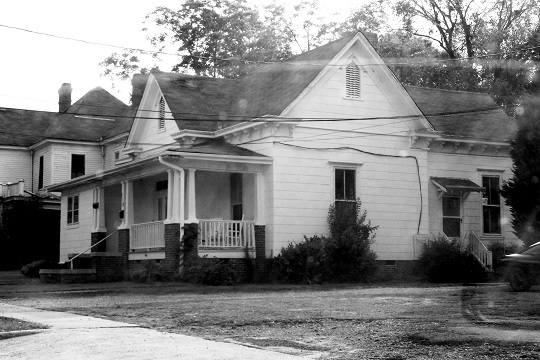
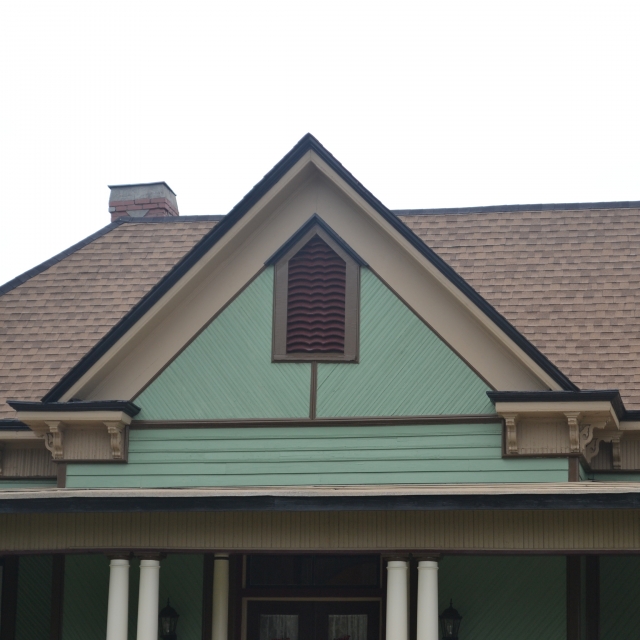
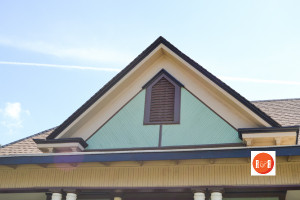
Built circa 1890, this house was moved to this site (after 1910 – the Sanborn Map for that years shows a vacant lot), from its original location at the northeast corner of Main and Reid Streets in 1905. Built in a late Victorian style the house features a hipped roof with gable extensions over the side and rear. There is also a gable dormer with louvered attic vent. It has paired tapered wood posts on brick pedestals. There is a rear facing gabled extension and a projecting side gable on the left. The house has asbestos siding.
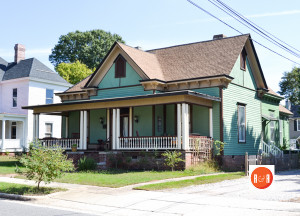
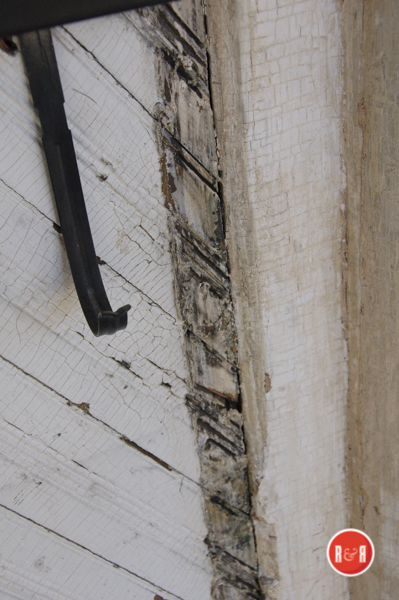
Images taken by R&R in 2015
In the 20th century, the house was divided and turned into two separate apartments. This removed the grand hallway and allowed entry into the living quarters. The side entry become the main entrance for the back apartment. Some original mantels, wood detailing and doors still remained following these extensive alterations to the home.
In the 21st century, the home has been lovingly restored by the current owners, Shaun and Jana Woods.
REID STREET NEIGHBORHOOD AT A GLANCE – In 1992, the Reid Street-North Confederate Avenue Area Historic District was placed in the National Register of Historic Places. The district includes the White House, which had been placed in the register as an individual property in 1969. East Main Street, Reid Street and Confederate Avenue developed as one of the first residential neighborhoods surrounding the downtown area of Rock Hill. By the 1870s, houses were being built along East Main Street several blocks from the originally platted area of the community. In 1888, the first public graded school was built nearby on Black Street. Central School served the community for many years, and today the site of the school is occupied by the Central Child Development Center. A street was opened between Main and Black which terminated at the school. Originally called Academy Street, the name was later changed to Confederate Avenue. Reid Street was opened just after the turn of the century, and the entire area rapidly filled with houses.
The families who moved into this neighborhood were largely middle class business or professional families. Most worked in the downtown area, only a two to three block walk away. Several of the early home owners were employed as teachers or government workers. Merchants included R. W. Cranford, who operated a department store, Arthur Patterson (wholesale grocery), James Huey (pharmacy), John Good (stable), and the Barnes and Workman families (telephone business). Dr. W. R. Blackmon lived on Main Street and other residents of the area included the superintendent of the Highland Park Mill (Charles Steed), and a railway conductor (Ernest Guntharp). R. E. Tomkins moved his family from Kershaw to East Main Street so that his children could benefit from the new school.
Most of the earliest houses in the neighborhood were in late Victorian Styles, including one-story cottages and two-story homes. Several excellent Victorian homes remain on North Confederate Avenue and Reid Street. The John Good House (c. 1895), located at the corner of East Main and Confederate, is an exceptional Late Victorian home. Later houses were built in the emerging Classical Revival style. Just after 1900, some of the earlier Victorian houses on East Main Street were moved to Reid Street. These one-story Victorian cottages were replaced by larger classical revival homes. Apparently, East Main Street was becoming more fashionable, and the cottages had gone out of style and were too small for the area.
This neighborhood is still largely intact and represents one of the best collections of historic homes in Rock Hill. We are indebted to the property owners who have maintained and restored these beautiful houses. [Written and contributed to R&R by Paul M. Gettys]
Click on the More Information > link found below the picture column for additional data or pictures.
Stay Connected
Explore history, houses, and stories across S.C. Your membership provides you with updates on regional topics, information on historic research, preservation, and monthly feature articles. But remember R&R wants to hear from you and assist in preserving your own family genealogy and memorabilia.
Visit the Southern Queries – Forum to receive assistance in answering questions, discuss genealogy, and enjoy exploring preservation topics with other members. Also listed are several history and genealogical researchers for hire.
User comments welcome — post at the bottom of this page.
R&R HISTORY LINK: CONTRACTOR HISTORY
Please enjoy this structure and all those listed in Roots and Recall. But remember each is private property. So view them from a distance or from a public area such as the sidewalk or public road.
Do you have information to share and preserve? Family, school, church, or other older photos and stories are welcome. Send them digitally through the “Share Your Story” link, so they too might be posted on Roots and Recall.
Thanks!

User comments always welcome - please post at the bottom of this page.


Share Your Comments & Feedback: