Courtesy of the Willis Collection – 2016
City Directories and History:The Walter Scott Montgomery House, located in a commercially developed area of Spartanburg, is a two-and-one-half-story, brick-veneer residence built in 1909 for Walter Scott Montgomery. The Neo-Classical and Colonial Revival style residence was designed by George F. Barber and constructed by the Fiske-Carter Construction Company. It is significant for its association with Montgomery, prominent Spartanburg businessman and civic leader, as well as for its Barber design and the quality of craftsmanship. Barber, who practiced architecture in Knoxville, Tennessee, from 1889 to 1915, was noted primarily for his mail-order houses that he publicized in numerous catalogues and sold nationwide. The house is typical of the type called “Classical Colonial” by Barber. The building is of frame construction with a yellow brick veneer and a red tile roof. In addition to its design, the Walter Scott Montgomery House is significant for its craftsmanship. The intricate and elegant plaster ornamentation, the detailing of the portico, and the leaded glass in the entrances are especially noteworthy. The property includes a one-story, reinforced concrete auto garage that was built before 1923. Listed in the National Register November 1, 1984.
View the complete text of the nomination form for this National Register property (Courtesy of South Carolina Department of Archives and History)
———–
Perhaps the greatest factor in the future development of the resources of Spartanburg will be the immense Spartan Mills, which commenced operations recently. In 1888 the Spartan Mills were organized with a capital stock of $150,000, payable in shares of $100 upon the cooperative plan of one dollar a month on each share. This plan was found to be slow and unsatisfactory, but work began in April 1889 with a view to erect a mill of ten thousand spindles.
Then a proposal came from Northern capitalists to join the Spartan Mills on the condition that the Spartanburg people would increase their subscription to create a capital stock of $500,000. The company was speedily organized with these officers: John H. Montgomery, president and treasurer; W.E. Burnett, vice president; Alvin Green, superintendent; directors, J.H. Montgomery, A.H. Twitchell, John B. Cleveland, D.R. Duncan, W.E. Burnett, J.L.H. Cobb of Lewiston, Me., Stephen Green of Newburyport, Mass., S.M. Milliken of New York, and G.W. Donaldson of Providence, R.I.
The main building, which catches the eye of perhaps every passenger by ten boilers of 120 horse power each. Next to the boiler room is the heating arrangement which is entirely new in this section. Instead of steam pipes running through the mill, two large fans are used to drive hot air through flues built in the wall and into each room. By this arrangement during hot weather cold air is driven into the compartments—the same machine thus serving two purposes, that of ventilating as well as heating.
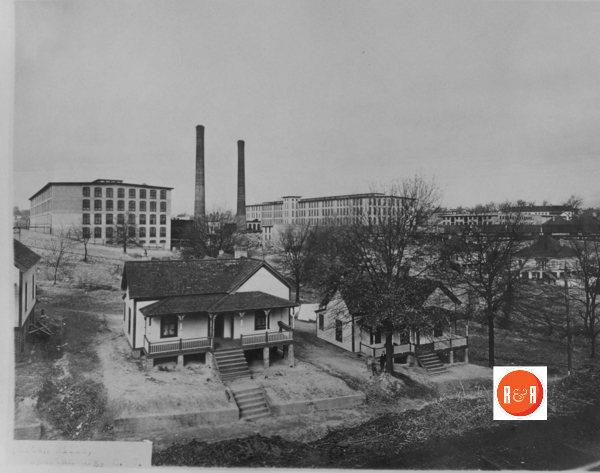
The smoke stack is the highest structure of the kind in the State. It is 178 feet in height, and its base is 40 feet in diameter. Furthermore, it is probably the only round chimney in the South. The company owns about 60 acres of land, all within the corporate limits of the city. Upon this property has been built the largest and best equipped cotton mill in the Southern States.
Nearby is Montgomeryville, made up of 150 neat cottages, with four rooms each, in which will live the operatives. There are still 24 acres of untouched land. These tenements are intended for one family only to each house. They are built of dressed lumber, ceiled throughout, and have been neatly painted a drab color with brown borderings. About fifty of these houses are already occupied, and families are moving in as the mills near completion. With a population of 1,500 souls this little village will be a valuable adjunct to the already prosperous municipality of Spartanburg.
Spartan Mills, the largest in the State, will consume about one-third of the cotton crop raised in the county. The company has now put in 3,500 spindles and 1,100 looms and will yet have ample space of fully 5,000 additional spindles and several hundred looms. The mills will be lighted with the Thomson-Houston system of incandescent electric lights. Recently the stock of the company has been increased to one million dollars.
(Reprinted from South Carolina in the 1880s: A Gazetteer by J.H. Moore, Sandlapper Publishing Company – 1989″
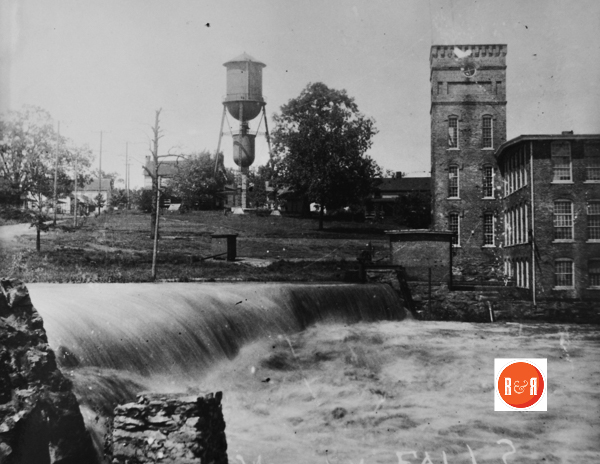
Images courtesy of the Meek Collection – 2016
Membership in R&R
Stay connected with R&R, “Explore S.C. history, historic houses, & family stories…” Sign up for a free R&R membership. Members receive the “From the Porch” blog, updates on regional topics, and targeted notifications of their choice. Membership also includes travel opportunities: Carolina DeJaunts. Login and prioritize your specific points of enthusiasm. If you only wish to receive the “From the Porch” newsletter and no additional membership content, use the R&R Blog signup form.
User comments welcome – post at the bottom of this page.
Please enjoy this structure and all those listed in Roots and Recall. But remember each is private property. So view them from a distance or from a public area such as the sidewalk or public road.
Do you have information to share and preserve? Family, school, church, or other older photos and stories are welcome. Send them digitally through the “Share Your Story” link, so they too might be posted on Roots and Recall.
Thanks!


-

- Images of the home in the 1980s courtesy of the SCDAH.